
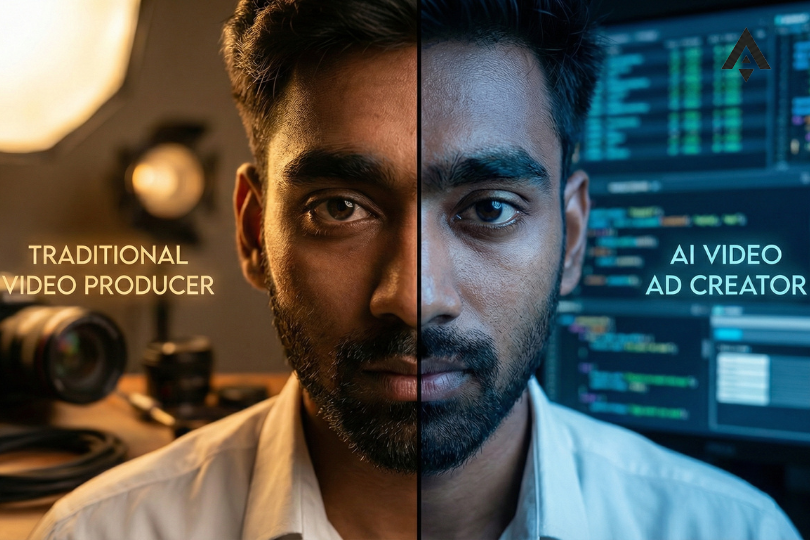
Traditional video production focuses on creating one finished advertisement through a long, linear process. An AI video ad creator, on the other hand, uses intelligent tools and strategic thinking to create, test, and adapt multiple versions quickly. The difference is not just about speed—it is about flexibility, scalability, and smarter communication.
Contents
- 1 How Traditional Video Production Works?
- 2 The Limits of Traditional Production in Today’s Digital World
- 3 What Makes an AI Video Ad Creator Different?
- 4 Linear Process vs. Adaptive Workflow
- 5 Speed Without Losing Thoughtfulness
- 6 One Output vs. Many Possibilities
- 7 Cost Structure and Resource Use
- 8 Creative Control Still Belongs to Humans
- 9 Why Modern Brands Prefer Adaptive Production?
- 10 The Shift From Projects to Systems
- 11 When Traditional Production Still Makes Sense
- 12 A New Balance Between Craft and Technology
- 13 Conclusion
- 14 Other common queries to explore…….
How Traditional Video Production Works?
For many years, advertising followed a familiar model.
A team planned a concept, filmed the content, edited it, and delivered one final version.
This process usually included:
- Pre-production planning
- Filming and asset creation
- Manual editing and revisions
- Final delivery for limited platforms
Traditional production is structured and detailed. But it is also slow and difficult to adapt once completed.
The Limits of Traditional Production in Today’s Digital World
Modern audiences do not interact with content the way they did before.
People scroll quickly. Platforms change constantly. Campaigns must evolve in real time.
Traditional workflows struggle because:
- They produce one version instead of many
- Changes require restarting the process
- Testing different ideas takes too long
- Scaling content requires more time and cost
This is where the AI video ad creator introduces a new approach.
What Makes an AI Video Ad Creator Different?
An AI video ad creator does not replace traditional creativity.
They redesign how creative work happens.
Instead of a one-time production cycle, they build flexible systems that allow:
- Faster content generation
- Multiple creative variations
- Continuous improvement through insights
- Adaptation across platforms instantly
The focus shifts from “making a video” to “managing communication.”
Linear Process vs. Adaptive Workflow
Traditional Production Is Linear
Traditional workflows follow a straight path:
[Idea → Shoot → Edit → Deliver → Stop]
Once completed, the ad remains fixed.
AI Video Ad Creator Workflow Is Cyclical
An AI video ad creator works in repeating cycles:
[Create → Test → Learn → Adjust → Improve]
This allows advertising to evolve based on audience response rather than staying static.
Speed Without Losing Thoughtfulness
Speed is often misunderstood as rushing.
In reality, an AI video ad creator uses AI to handle repetitive tasks so more time can be spent thinking strategically.
AI assists with:
- Formatting multiple versions
- Managing edits efficiently
- Identifying performance trends
- Scaling production without duplication of effort
The creator remains responsible for direction and meaning.
One Output vs. Many Possibilities
Traditional production aims to deliver a single polished result.
An AI video ad creator explores many possibilities before deciding what works best.
This approach enables:
- A/B testing of creative ideas
- Platform-specific adaptations
- Continuous refinement
- Faster feedback cycles
Instead of committing to one version, the creator learns from real audience behavior.
Cost Structure and Resource Use
Traditional production often requires larger teams and longer timelines.
Adjustments can increase cost because changes require repeating steps.
An AI video ad creator optimizes resources by:
- Automating repetitive production tasks
- Reducing time spent on manual adjustments
- Allowing faster iteration without restarting
This does not eliminate effort—it redirects it toward strategy and storytelling.
Creative Control Still Belongs to Humans
A common misconception is that AI removes human input.
In reality, the AI video ad creator maintains full creative control.
They decide:
- What story to tell
- How visuals should feel
- Which version aligns with goals
- When to adjust messaging
AI simply makes execution more efficient.
Why Modern Brands Prefer Adaptive Production?
Today’s communication environment demands relevance.
Campaigns must adjust to trends, platforms, and audience behavior quickly.
Working with an AI video ad creator allows brands to:
- Respond faster to changes
- Maintain consistent messaging
- Experiment safely before scaling
- Keep content aligned with real performance data
This adaptability makes advertising more effective over time.
The Shift From Projects to Systems
Traditional production treats each campaign as a separate project.
An AI video ad creator builds systems that continue working beyond a single campaign.
These systems allow:
- Ongoing content development
- Reusable creative frameworks
- Continuous optimization
- Smarter long-term communication strategies
This approach transforms advertising into an evolving process rather than a one-time effort.
When Traditional Production Still Makes Sense
Traditional methods remain valuable for:
- Large cinematic productions
- Highly specialized storytelling formats
- Projects that require extensive physical filming
But for fast-moving digital marketing, the flexibility of an AI video ad creator provides clear advantages.
A New Balance Between Craft and Technology
The goal is not to replace traditional production.
It is to balance craftsmanship with adaptability.
An AI video ad creator respects creative fundamentals while embracing tools that make communication more responsive and scalable.
Conclusion
The difference between traditional production and an AI video ad creator lies in mindset as much as method. Traditional workflows focus on creating a finished product. The AI-driven approach focuses on continuous improvement and adaptability.
By combining human creativity with intelligent tools, the AI video ad creator enables advertising that evolves alongside audiences, platforms, and business needs.
The future of video advertising is not about choosing between tradition and technology.
It is about integrating both thoughtfully.
Other common queries to explore…….
- 14 Fast Facts About an AI Video Ad Creator (The Human Behind AI-Powered Advertising)
- 10 Predictions About the Future of AI Video Ad Creator
- What Do You Want to Read About Next? A Fresh Look on AI Video Ad Creator
- 10 Signs It’s Time to Invest in an AI Video Ad Creator for Your Business
- AI Video Ad Creator vs Traditional Video Production: What’s the Real Difference?
- How an AI Video Ad Creator Helps Brands Produce 10x More Content Without Burnout
- Why Hire an AI Video Ad Creator in Chennai Today?
- The Day a Chennai Business Stopped Shooting Videos — and Started Communicating
Follow me on,
1. Linkedin – https://www.linkedin.com/in/creator-surya-kumar/
2. Medium – https://medium.com/@creatorsuryakumar